Understanding Light: The Contemplative Pedagogy of Edith Stein
DOI:
https://doi.org/10.51743/cpe.475Palabras clave:
carmelites, contemplative pedagogy, discernment, Edith Stein, religionResumen
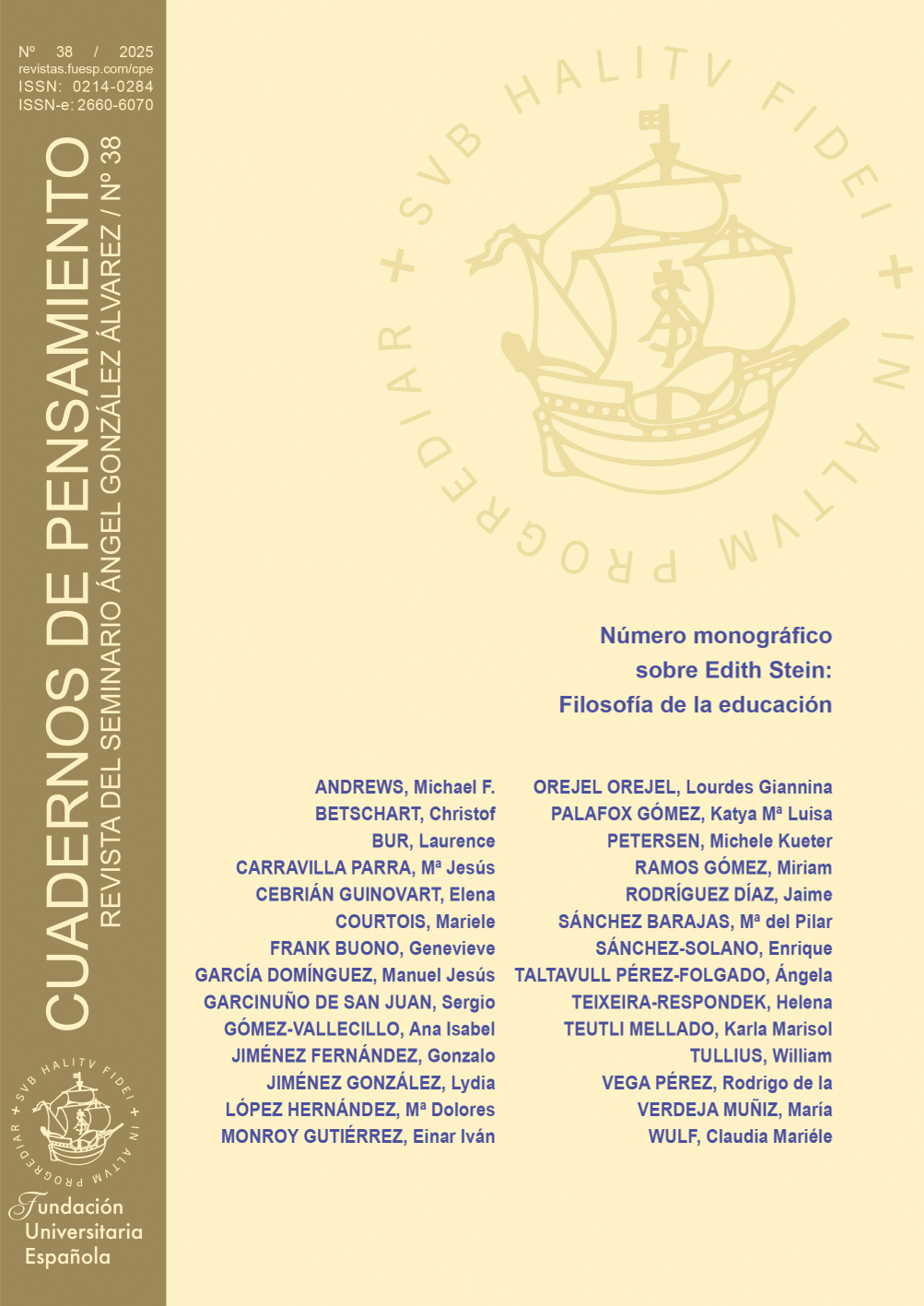
We learn to philosophize and reflect both on what we think and how we think about what we think when we think with Edith Stein about education and religion. This article seeks to illuminate the philosophical gifts that Stein brings to religious pedagogy, including her stance on the importance of the acceptance of the divine will to advance in spiritual discernment. Under her tutelage, what is often inculcated as the mere passive reception of the light of revelatory faith becomes a philosophically illuminating act of transformative transcendence. The call to teach and to learn thus cultivates not just passive belief but the emergence of great-souled moral force laying the ground for a new Age of Enlightenment centered on a light-bearing relational being-true rather than on the mere outward illumination of fact. In the cultivation of interiority, Stein imparts a contemporary rule of life in teaching and learning as a vocation whereby the evolution of individuality becomes an integrative flow between contemplation and action. To bear and to understand light is to learn to see in a new way with the eyes of faith. The relation between being and becoming in the intersection between education, vocation, and spirituality helps us come to recognize in the mystery of our lives and for the sake of others what it is that we should do. Stein lays out a contemplative pedagogy of the heart that reflects the intellectual rigor of her philosophical education and training in phenomenology as well as the spiritual vigor of her religious life.
Descargas
Citas
Ales Bello, A. (2018). The spiritual life and its degrees according to Edith Stein. In K. M. Haney (Ed.), Listening to Edith Stein: Wisdom for a new century: A collection of essays (17-45). ICS Publications.
Barth, K. (1961). Church Dogmatics. Vol. III The Doctrine of Creation Pt. Four (G.W. Bromiley & T.F. Torrance, Eds.; A.T. Mackay, T.H.L. Parker, H. Knight, H.A. Kennedy, J. Marks, Trans.). T. & T. Clark.
Borden Sharkey, S. (2003). Edith Stein. Continuum.
Graef, H. C. (1954). The scholar and the cross: The life and work of Edith Stein. Roman Catholic Books.
Larkin, E. E. (2021). Silent presence: Discernment as process and problem (2nd ed.). Carmelite Media.
Petersen, M. K. (2021). A hermeneutics of contemplative silence: Paul Ricoeur, Edith Stein, and the heart of meaning. Lexington Books.
Pope John Paul II. (2000). Homily at Canonization Eucharist. In J. Sullivan (Ed.), Holiness befits your house: Documentation on the canonization of Edith Stein (pp. 7-11). ICS Publications.
Stein, E. (1993). Self-Portrait in letters, 1916-1942 (L. Gelber & R. Leuven, Eds.; J. Koeppel, Trans.). ICS Publications.
Stein, E. (1996). Essays on woman (L. Gelber & R. Leuven, Eds.; F. M. Oben, Trans.; 2nd Rev. ed.). ICS Publications.
Stein, E. (2000). Philosophy of psychology and the humanities (M. Sawacki, Ed.; M. C. Baseheart & M. Sawacki, Trans.). ICS Publications.
Stein, E. (2002a). Finite and eternal being: An attempt at an ascent to the meaning of being (L. Gelber & R. Leuven, Eds.; K. F. Reinhardt, Trans.). ICS Publications.
Stein, E. (2002b). The science of the cross (L. Gelber & R. Leuven, Eds.; J. Koeppel, Trans.). ICS Publications.
Stein, E. (2014). Edith Stein: Letters to Roman Ingarden (M. A. Neyer & E. Avé-Lallemant, Eds.; H. C. Hunt, Trans.). ICS Publications.
Descargas
Publicado
Versiones
- 2025-12-10 (3)
- 2025-12-09 (2)
- 2025-12-05 (1)
Cómo citar
Número
Sección
Licencia
Derechos de autor 2025 Michele Kueter Petersen

Esta obra está bajo una licencia internacional Creative Commons Atribución-NoComercial 4.0.
El autor conserva los derechos patrimoniales (copyright) de las obras publicadas, y la revista favorece y permite la reutilización de las mismas, desde el preprint. Las obras se publican en la edición electrónica de la revista bajo una licencia “Creative Commons Atribución/Reconocimiento-NoComercial 4.0 Licencia Pública Internacional — CC BY-NC 4.0”, y se pueden copiar, usar, difundir, transmitir y exponer públicamente .
Los autor/es transfieren parcialmente los derechos de propiedad del presente trabajo para las ediciones impresas y online, siempre que:
- Se cite la autoría y la fuente original de su publicación (revista, editorial y URL de la obra).
- No se usen para fines comerciales.
- Se mencione la existencia y especificaciones de esta licencia de uso.
Se declara además haber respetado los principios éticos de investigación y estar libre de cualquier conflicto de intereses.
«C.P.E.» anima a los autores y a la comunidad científica a la máxima promoción y difusión de los trabajos en su versión definitiva a través de:
1) Su lista de contactos (mails) y redes sociales (Facebook, Twitter, LinkedIn…).
2) Repositorio institucional de su Universidad y repositorios públicos (Mendeley, Cosis…).
3) Redes sociales científicas (ResearchGate, Academia.edu, Kudos...).
4) Web personal o institucional, blog, etc.
5) Google Scholar, ORCID, ResearchID, ScopusID, Dimensions, PlumX...
6) Ejemplares impresos adquiridos directamente y enviados a especialistas para su lectura y posterior citación si procede.



















1.png)
1.png)

1.png)


.png)
.png)

.png)
1.png)
1.png)