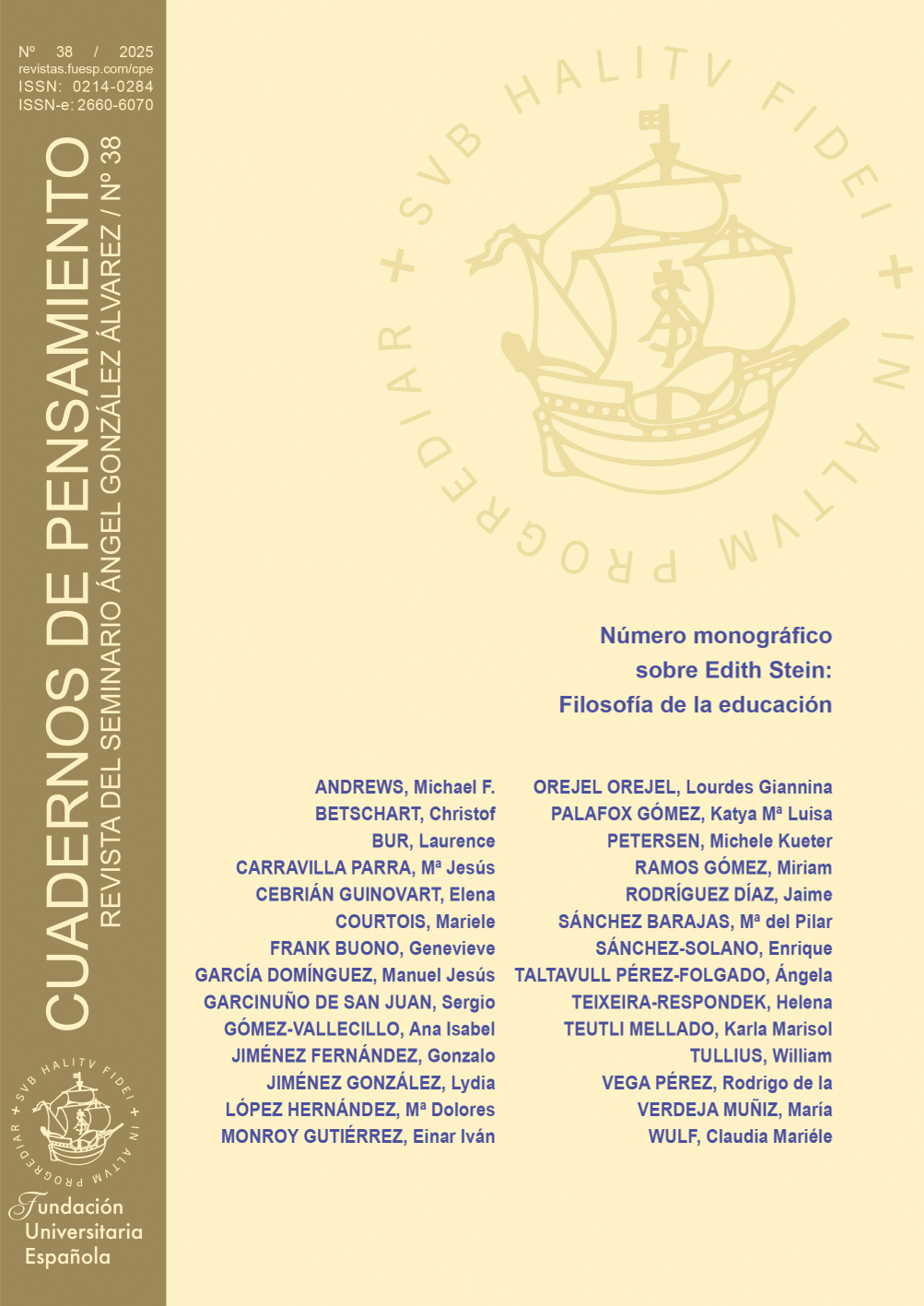
Mothering a Gift of God: How Edith Stein’s Theology of Education Opposes the Technocratic Paradigm
DOI:
https://doi.org/10.51743/cpe.508Palabras clave:
Edith Stein, education, pedagogy, technocratic paradigm, technology ethicsResumen
As the field of education is increasingly influenced by AI technologies, it becomes difficult to ascertain whether teaching methods are adequately cultivating human capacities fully. The technocratic paradigm can permit a utilitarian vision of education that overlooks personal vocation and perpetuates a distorted vision of where we encounter her vision for education, the essential nature of woman is characterized as having qualities that present a direct contrast to the features of the technocratic paradigm. Though Stein does not herself use the term technocratic
paradigm, her description of the vices and structures that challenge the formation of women parallel the problems caused by the technocratic paradigm, such as a failure to
recognize the truth of creation, reductionism, and a lack of care for creation integrally understood. The gifts and virtues of women’s souls can be seen as a counter to the dangers of a technocratic era ‒ and perhaps by extension, a key to redeeming technology to a proper relationship with humanity, the created world, and the divine. This paper will first demonstrate the connections between Pope Francis’s portrayal of the technocratic paradigm from his encyclical Laudato Si’ and the threats and challenges to true education as described by Stein. Then, features of feminine nature that contrast with the technocratic paradigm will be described. Finally, suggestions are offered for a pedagogical approach that forms both men and women toward relationship with God rather than according to technocratic aims. Ultimately, Stein’s educational insights challenge a technocratic educational system and help students to unfold their authentic selves as gifts from God.
Descargas
Citas
AI Research Group for the Centre for Digital Culture of the Dicastery for Culture and Education of the Holy See. (2024.) Encountering Artificial Intelligence: Ethical and Anthropological Investigations. Ed. Matthew J. Gaudet, Noreen Herzfeld, Paul Scherz, and Jordan J. Wales. Pickwick Publications.
Arendt, H. (2018.) The Human Condition. 2nd ed. University of Chicago Press.
Berdyaev, N. (1983.) “Man and Machine.” In Philosophy and Technology, edited by Carl Mitcham and Robert Mackey. Free Press., 203–11.
Borgman, A. (1987.) Technology and the Character of Contemporary Life. University of Chicago Press., 155–249.
Choukas-Bradley, S., Roberts, S. R., Maheux, A. J., & Nesi, J. (2022.) The Perfect Storm: A Developmental Sociocultural Framework for the Role of Social Media in Adolescent Girls’ Body Image Concerns and Mental Health. Clinical Child and Family Psychology Review, 25: 681–701.
Courtois, M. (2025.) “Among His Own Kin and in His Own House: Artificial Intelligence and the Interrelational Cultivation of Prudence.” Journal of Religious Ethics, 53 (2).
Courtois, M. (2022.) Biomedical Challenges to Identity and Parenthood: An Investigation into the Ethics of Genetic Technologies at the Beginning of Life. Ph.D. diss., The Catholic University of America.
Francis. (2016.) Amoris Lætitia. Vatican translation. Libreria Editrice Vaticana, AAS 100 (12).
Francis. Laudato Si’. Vatican translation. Vatican City: Libreria Editrice Vaticana, 2015, AAS 107.
Haidt, J. (2024.) The Anxious Generation: How the Great Rewiring of Childhood Is Causing an Epidemic of Mental Illness. Penguin Press.
Hanby, M. (2015.) The Gospel of Creation and the Technocratic Paradigm: Reflections on a Central Teaching of Laudato Si’. Communio: International Catholic Review, 42: 724–747.
John Paul II. (1981.) Laborem Exercens. Vatican translation. Libreria Editrice Vaticana, AAS 73.
McKenny, G. (2018.) Biotechnology, Human Nature, and Christian Ethics. Cambridge University Press.
Papageorgiou, A., Cross, D., Fisher, C. (2023.) Sexualized Images on Social Media and Adolescent Girls’ Mental Health: Qualitative Insights from Parents, School Support Service Staff and Youth Mental Health Service Providers. International Journal of Environmental Research and Public Health, 20 (1): 433–450.
Ramelow, A. (2024.) Technology and Our Relationship with God. Nova et Vetera, 22 (1): 159–186.
Scherz, P. (2021.) The Challenge of Technology to Moral Theology. Journal of Moral Theology, 10(2): 239–268.
Scherz, P. (2024.) AI as Person, Paradigm, and Structure: Notes toward an Ethics of AI. Theological Studies 85 (1): 124–144.
Second Vatican Ecumenical Council. Gaudium et Spes: Pastoral Constitution on the Church in the Modern World. Vatican translation. Vatican City: Libreria Editrice Vaticana, 1966, 59: AAS 58.
Stein, E. (1996.) Die Frau: Ihre Aufgabe nach Natur und Gnade. Eds. L. Gelber and Romaeus Leuven. Edith Steins Werke V. Druten, Netherlands: De Maas & Waler. English transl. by Freds Mary Oben. 2nd and revised edition. The Collected Works of Edith Stein, vol. 2. ICS Publications.
Stein, E. (1993.) Selbstbildnis in Briefen (Self-Portrait in Letters): 1916–1942. Ed. L. Gelber, R. Leuven (Druten: De Maas & Waler, 1976–1977). English transl. by Josephine Koeppel. ICS Publications.
Stein, E. (1962.) Welt und Person. Werk VI. Nauwelaerts-Herder.
Descargas
Publicado
Versiones
- 2025-12-09 (3)
- 2025-12-09 (2)
- 2025-12-05 (1)
Cómo citar
Número
Sección
Licencia
Derechos de autor 2025 Mariele Courtois

Esta obra está bajo una licencia internacional Creative Commons Atribución-NoComercial 4.0.
El autor conserva los derechos patrimoniales (copyright) de las obras publicadas, y la revista favorece y permite la reutilización de las mismas, desde el preprint. Las obras se publican en la edición electrónica de la revista bajo una licencia “Creative Commons Atribución/Reconocimiento-NoComercial 4.0 Licencia Pública Internacional — CC BY-NC 4.0”, y se pueden copiar, usar, difundir, transmitir y exponer públicamente .
Los autor/es transfieren parcialmente los derechos de propiedad del presente trabajo para las ediciones impresas y online, siempre que:
- Se cite la autoría y la fuente original de su publicación (revista, editorial y URL de la obra).
- No se usen para fines comerciales.
- Se mencione la existencia y especificaciones de esta licencia de uso.
Se declara además haber respetado los principios éticos de investigación y estar libre de cualquier conflicto de intereses.
«C.P.E.» anima a los autores y a la comunidad científica a la máxima promoción y difusión de los trabajos en su versión definitiva a través de:
1) Su lista de contactos (mails) y redes sociales (Facebook, Twitter, LinkedIn…).
2) Repositorio institucional de su Universidad y repositorios públicos (Mendeley, Cosis…).
3) Redes sociales científicas (ResearchGate, Academia.edu, Kudos...).
4) Web personal o institucional, blog, etc.
5) Google Scholar, ORCID, ResearchID, ScopusID, Dimensions, PlumX...
6) Ejemplares impresos adquiridos directamente y enviados a especialistas para su lectura y posterior citación si procede.


















1.png)
1.png)

1.png)


.png)
.png)

.png)
1.png)
1.png)