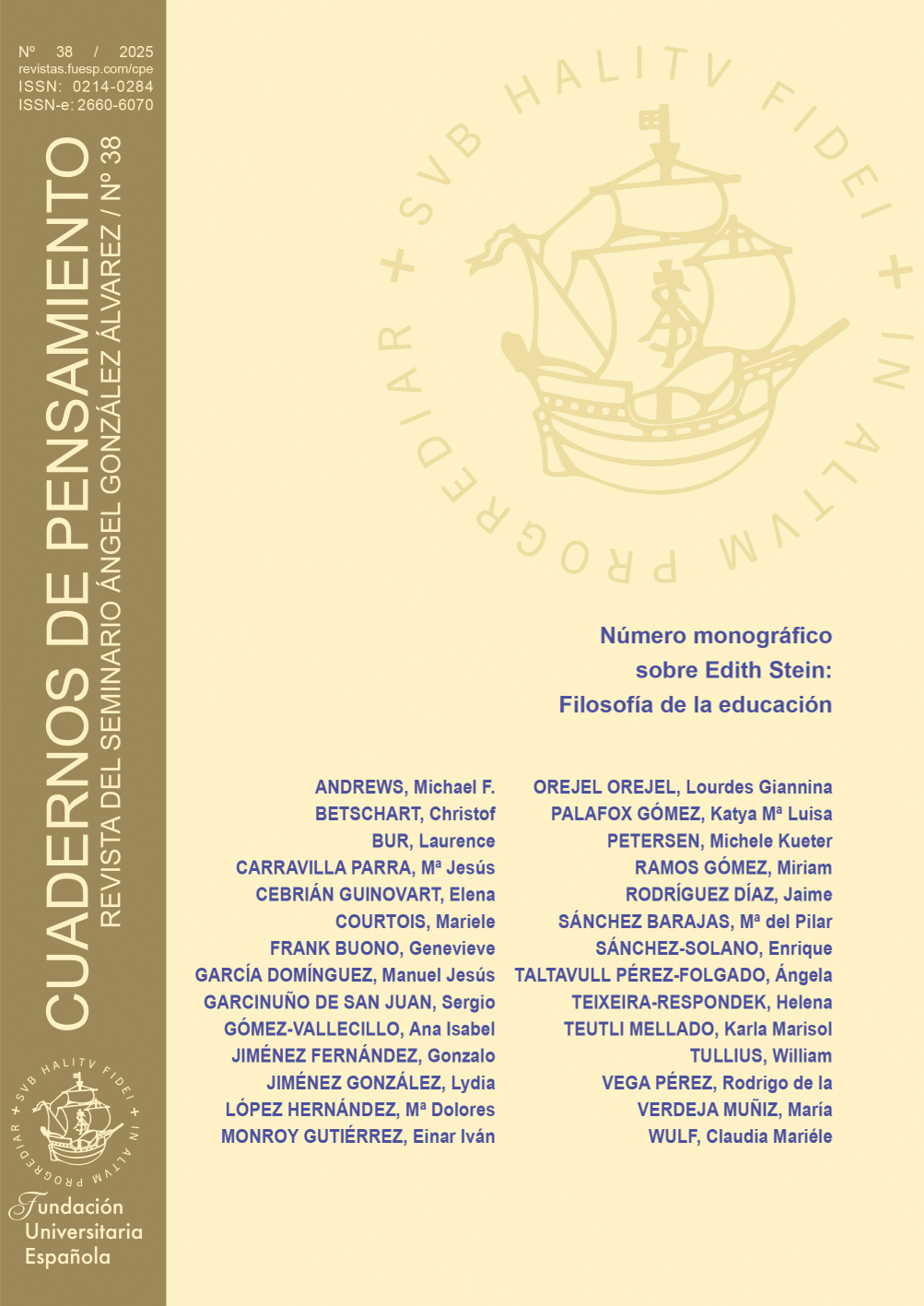
La maternidad, un don de Dios: Cómo la teología de la educación de Edith Stein se opone al paradigma tecnocrático
DOI:
https://doi.org/10.51743/cpe.508Keywords:
Edith Stein, educación, ética de la tecnología, paradigma tecnocrático, pedagogíaAbstract
A medida que el ámbito educativo se ve cada vez más influenciado por las tecnologías de IA, resulta difícil determinar si los métodos de enseñanza están cultivando adecuadamente las capacidades humanas en su totalidad. El paradigma tecnocrático puede fomentar una visión utilitaria de la educación que pasa por alto la vocación personal y perpetúa una visión distorsionada de la naturaleza humana creada por Dios. A este respecto, Edith Stein, en sus conferencias sobre la mujer, con su visión de la educación, concibe la naturaleza esencial de la mujer caracterizada por tener cualidades que contrastan directamente con las características del paradigma tecnocrático. Aunque Stein no utiliza el término “paradigma tecnocrático”, su descripción de los vicios y de las estructuras que dificultan la formación de las mujeres es paralela a los problemas causados por el paradigma tecnocrático, como el fracaso en reconocer la verdad de la Creación, el reduccionismo y la falta de cuidado por la Creación entendida de manera integral. Los dones y virtudes del alma de la mujer pueden considerarse una contrapartida a los peligros de la era tecnocrática y, por extensión, una clave para redimir la tecnología y llevarla a una relación adecuada con la humanidad, el mundo creado y lo divino. Por ello, en este artículo se demostrarán en primer lugar las conexiones entre la descripción del paradigma tecnocrático según el papa Francisco en su encíclica Laudato Si’ y las amenazas y retos para la educación auténtica descritos por Stein. A continuación, se describirán las características de la naturaleza femenina que contrastan con el paradigma tecnocrático. Por último, se ofrecerán sugerencias para un enfoque pedagógico que forme tanto a hombres como a mujeres desde el punto de vista de su relación con Dios, en lugar de según los objetivos tecnocráticos. En última instancia, las ideas de Stein sobre la educación desafían al sistema educativo tecnocrático y ayudan a los estudiantes a desarrollar su auténtico yo como un don de Dios.
Downloads
References
AI Research Group for the Centre for Digital Culture of the Dicastery for Culture and Education of the Holy See. (2024.) Encountering Artificial Intelligence: Ethical and Anthropological Investigations. Ed. Matthew J. Gaudet, Noreen Herzfeld, Paul Scherz, and Jordan J. Wales. Pickwick Publications.
Arendt, H. (2018.) The Human Condition. 2nd ed. University of Chicago Press.
Berdyaev, N. (1983.) “Man and Machine.” In Philosophy and Technology, edited by Carl Mitcham and Robert Mackey. Free Press., 203–11.
Borgman, A. (1987.) Technology and the Character of Contemporary Life. University of Chicago Press., 155–249.
Choukas-Bradley, S., Roberts, S. R., Maheux, A. J., & Nesi, J. (2022.) The Perfect Storm: A Developmental Sociocultural Framework for the Role of Social Media in Adolescent Girls’ Body Image Concerns and Mental Health. Clinical Child and Family Psychology Review, 25: 681–701.
Courtois, M. (2025.) “Among His Own Kin and in His Own House: Artificial Intelligence and the Interrelational Cultivation of Prudence.” Journal of Religious Ethics, 53 (2).
Courtois, M. (2022.) Biomedical Challenges to Identity and Parenthood: An Investigation into the Ethics of Genetic Technologies at the Beginning of Life. Ph.D. diss., The Catholic University of America.
Francis. (2016.) Amoris Lætitia. Vatican translation. Libreria Editrice Vaticana, AAS 100 (12).
Francis. Laudato Si’. Vatican translation. Vatican City: Libreria Editrice Vaticana, 2015, AAS 107.
Haidt, J. (2024.) The Anxious Generation: How the Great Rewiring of Childhood Is Causing an Epidemic of Mental Illness. Penguin Press.
Hanby, M. (2015.) The Gospel of Creation and the Technocratic Paradigm: Reflections on a Central Teaching of Laudato Si’. Communio: International Catholic Review, 42: 724–747.
John Paul II. (1981.) Laborem Exercens. Vatican translation. Libreria Editrice Vaticana, AAS 73.
McKenny, G. (2018.) Biotechnology, Human Nature, and Christian Ethics. Cambridge University Press.
Papageorgiou, A., Cross, D., Fisher, C. (2023.) Sexualized Images on Social Media and Adolescent Girls’ Mental Health: Qualitative Insights from Parents, School Support Service Staff and Youth Mental Health Service Providers. International Journal of Environmental Research and Public Health, 20 (1): 433–450.
Ramelow, A. (2024.) Technology and Our Relationship with God. Nova et Vetera, 22 (1): 159–186.
Scherz, P. (2021.) The Challenge of Technology to Moral Theology. Journal of Moral Theology, 10(2): 239–268.
Scherz, P. (2024.) AI as Person, Paradigm, and Structure: Notes toward an Ethics of AI. Theological Studies 85 (1): 124–144.
Second Vatican Ecumenical Council. Gaudium et Spes: Pastoral Constitution on the Church in the Modern World. Vatican translation. Vatican City: Libreria Editrice Vaticana, 1966, 59: AAS 58.
Stein, E. (1996.) Die Frau: Ihre Aufgabe nach Natur und Gnade. Eds. L. Gelber and Romaeus Leuven. Edith Steins Werke V. Druten, Netherlands: De Maas & Waler. English transl. by Freds Mary Oben. 2nd and revised edition. The Collected Works of Edith Stein, vol. 2. ICS Publications.
Stein, E. (1993.) Selbstbildnis in Briefen (Self-Portrait in Letters): 1916–1942. Ed. L. Gelber, R. Leuven (Druten: De Maas & Waler, 1976–1977). English transl. by Josephine Koeppel. ICS Publications.
Stein, E. (1962.) Welt und Person. Werk VI. Nauwelaerts-Herder.
Downloads
Published
Versions
- 2025-12-09 (3)
- 2025-12-09 (2)
- 2025-12-05 (1)
How to Cite
Issue
Section
License
Copyright (c) 2025 Mariele Courtois

This work is licensed under a Creative Commons Attribution-NonCommercial 4.0 International License.
The author reserves the rights (copyright) of the published works, and the journal encourages and allows their reuse, from the preprint. The works are published in the electronic edition of the journal under a license "Creative Commons Attribution / Attribution-NonCommercial 4.0 International Public License - CC BY-NC 4.0", and can be copied, used, disseminated, transmitted and publicly exhibited.
The author / s partially transfer the property rights (copyright) of this work for the printed and online editions, provided that:
- The authorship and original source of its publication (magazine, publisher and URL of the work) is cited.
- Are not used for commercial purposes.
- The existence and specifications of this user license are mentioned.
It also declares to have respected the ethical principles of research and to be free from any conflict of interest.
"C.P.E." encourages the authors and the scientific community to the maximum promotion and dissemination of the works in their final version through:
1) Your list of contacts (emails) and social networks (Facebook, Twitter, LinkedIn ...).
2) Institutional repository of your University and public repositories (Mendeley, Cosis ...).
3) Scientific social networks (ResearchGate, Academia.edu, Kudos ...).
4) Personal or institutional website, blog, etc.
5) Google Scholar, ORCID, ResearchID, ScopusID, Dimensions, PlumX ...
6) Printed copies purchased directly and sent to specialists for reading and subsequent citation if appropriate.




















1.png)
1.png)

1.png)


.png)
.png)

.png)
1.png)
1.png)