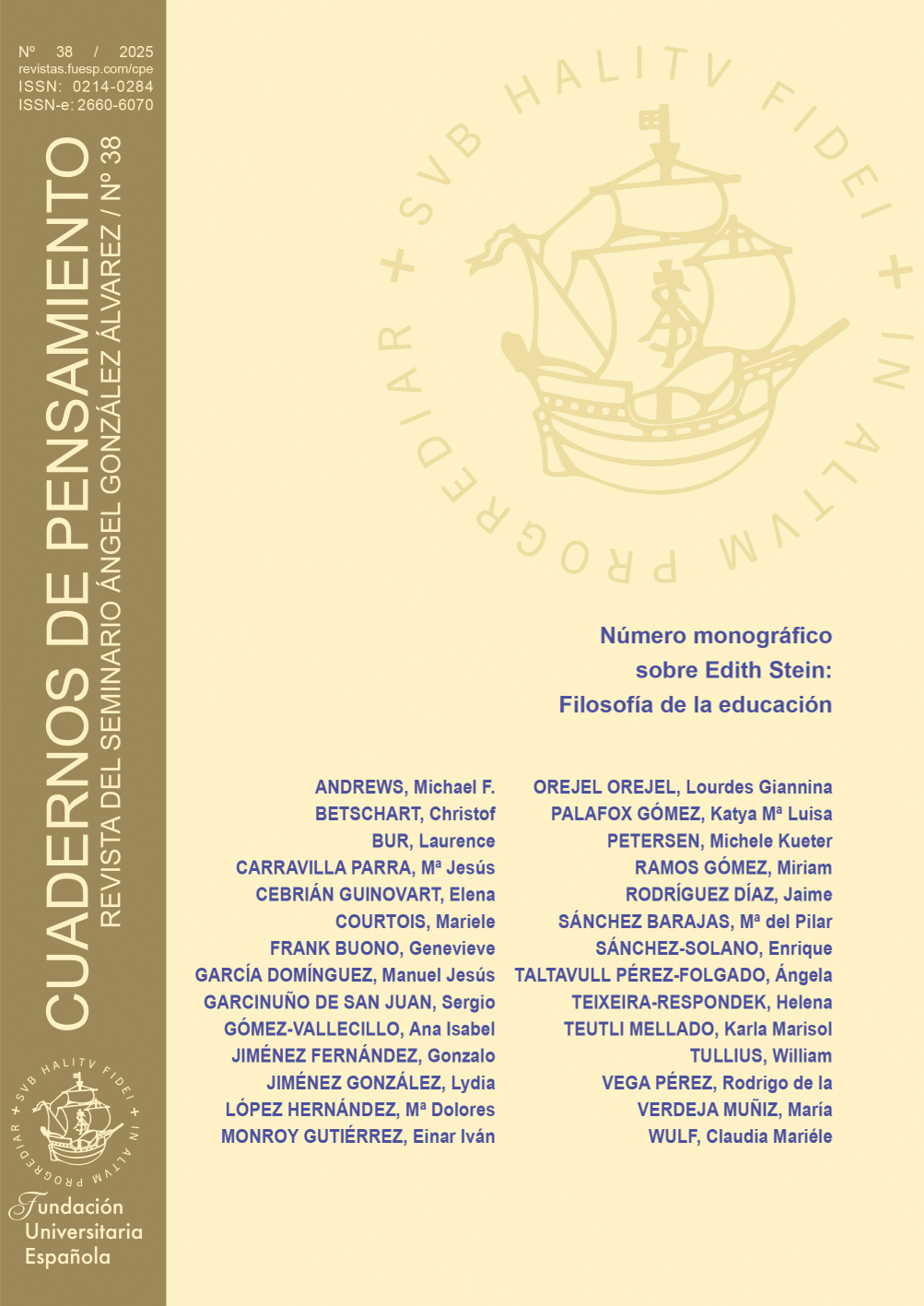
¿Puede el hombre integral ser el remedio para la enfermedad de nuestro tiempo? La contribución de Edith Stein a la práctica psicoterapéutica con el ejemplo de la Terapia de Integración Personal ADI/TIP
DOI:
https://doi.org/10.51743/cpe.464Keywords:
antropología, Edith Stein, formación humana, psicología, psicoterapiaAbstract
Parece que el siglo xxi exige urgentemente un retorno a la antropología de Edith Stein, ya que nos enfrentamos a una profunda crisis antropológica, es decir, a la falta de sentido de la vida, a la distorsión del significado de los valores que guían la vida humana y al reduccionismo filosófico, que convierte al ser humano en una unidad psicofísica bidimensional e invalida una dimensión plenamente humana (es decir, espiritual). Fue sorprendentemente el mismo diagnóstico que dio Edith Stein en la conferencia “El valor de la feminidad y su importancia en la vida del pueblo” en 1928, describiendo la desintegración interna del ser humano y cómo el hombre integral (que, según ella, es el remedio para la enfermedad de nuestro tiempo) puede ser una salida a la crisis contemporánea. Al parecer, la desintegración interna significa un debilitamiento de la dimensión espiritual del ser humano que hace que sus reacciones mentales y de comportamiento dependan más de los impulsos psicológicos y disminuye su capacidad de discernimiento de los valores y el proceso de toma de decisiones. El objetivo de este trabajo es presentar el diagnóstico de Edith Stein sobre la crisis antropológica contemporánea y a continuación, presentar la práctica psicoterapéutica de la Terapia de Integración Personal a través del método ADI/TIP, que mediante el fundamento teórico esténico, puede dejar de fragmentar al hombre para reconstituir su integridad.
Downloads
References
Alles Belo, A. (2018). The Role of Psychology According to Edith Stein. The Oxford Handbook of Phenomenological Psychopathology.
https://doi.org/10.1093/oxfordhb/9780198803157.013.2
Jost, M.C., & Goto, T.A. (2021b). Depression, Psychotherapie und Verä nderung: die ADI/TIP-Methode, Psychologie und Phänomenologie. SFU Forschungsbulletin SFU Research Bulletin 9/1, 42-64. https://doi.org/10.15135/2021.9.1.42-64
Jost de Moraes, R. (2008). O inconsciente sem fronteiras (11ª ed.). Editora Santuário.
Jost de Moraes, R. (2016). As chaves do inconsciente (31ª ed.). SPES.
Lebech, M. (2004). Study Guide to Edith Stein’s Philosophy of Psychology and the Humanities. Yearbook of the Irish Philosophical Society, 4 (ed. by M. Lebech, Maynooth). pp. 40-76. https://www.researchgate.net/publication/279688366_Study_Guide_to_Edith_Stein‘s_Philosophy_of_Psychology_and_the_Humanities
Lebech, M. (2006). Edith Stein’s Philosophy of Education in The Structure of the Human Person. Maynooth Philosophical Papers 3 (9999):163-177. https://mural.maynoothuniversity.ie/3009/1/Stein%27s_Education_Theory_MPP.pdf
Mahfoud, M., Massimi, M. (2013). Edith Stein e a Psicologia: teoria e pesquisa. Artesã Editora.
Stein, E. (2022). Budowa osoby ludzkiej. Wykład z antropologii filozoficznej. [eng. The Human Person‘s Structure]. Wydawnictwo Karmelitów Bosych.
Stein, E. (2021). Kobieta. Pytania i refleksje. [eng. Essays on woman]. Wydawnictwo Karmelitów Bosych.
Teixeira Respondek, H. (2022). O co chodzi w byciu człowiekiem? Antropologia Edyty Stein okiem psychologa [eng. What being a human is all about? Edith Stein‘s Anthropology through the Eye of a Psychologist]. Wydawnictwo Karmelitów Bosych.
Downloads
Published
Versions
- 2025-12-09 (3)
- 2025-12-09 (2)
- 2025-12-05 (1)
How to Cite
Issue
Section
License
Copyright (c) 2025 Helena Teixeira Respondek Respondek

This work is licensed under a Creative Commons Attribution-NonCommercial 4.0 International License.
The author reserves the rights (copyright) of the published works, and the journal encourages and allows their reuse, from the preprint. The works are published in the electronic edition of the journal under a license "Creative Commons Attribution / Attribution-NonCommercial 4.0 International Public License - CC BY-NC 4.0", and can be copied, used, disseminated, transmitted and publicly exhibited.
The author / s partially transfer the property rights (copyright) of this work for the printed and online editions, provided that:
- The authorship and original source of its publication (magazine, publisher and URL of the work) is cited.
- Are not used for commercial purposes.
- The existence and specifications of this user license are mentioned.
It also declares to have respected the ethical principles of research and to be free from any conflict of interest.
"C.P.E." encourages the authors and the scientific community to the maximum promotion and dissemination of the works in their final version through:
1) Your list of contacts (emails) and social networks (Facebook, Twitter, LinkedIn ...).
2) Institutional repository of your University and public repositories (Mendeley, Cosis ...).
3) Scientific social networks (ResearchGate, Academia.edu, Kudos ...).
4) Personal or institutional website, blog, etc.
5) Google Scholar, ORCID, ResearchID, ScopusID, Dimensions, PlumX ...
6) Printed copies purchased directly and sent to specialists for reading and subsequent citation if appropriate.




















1.png)
1.png)

1.png)


.png)
.png)

.png)
1.png)
1.png)