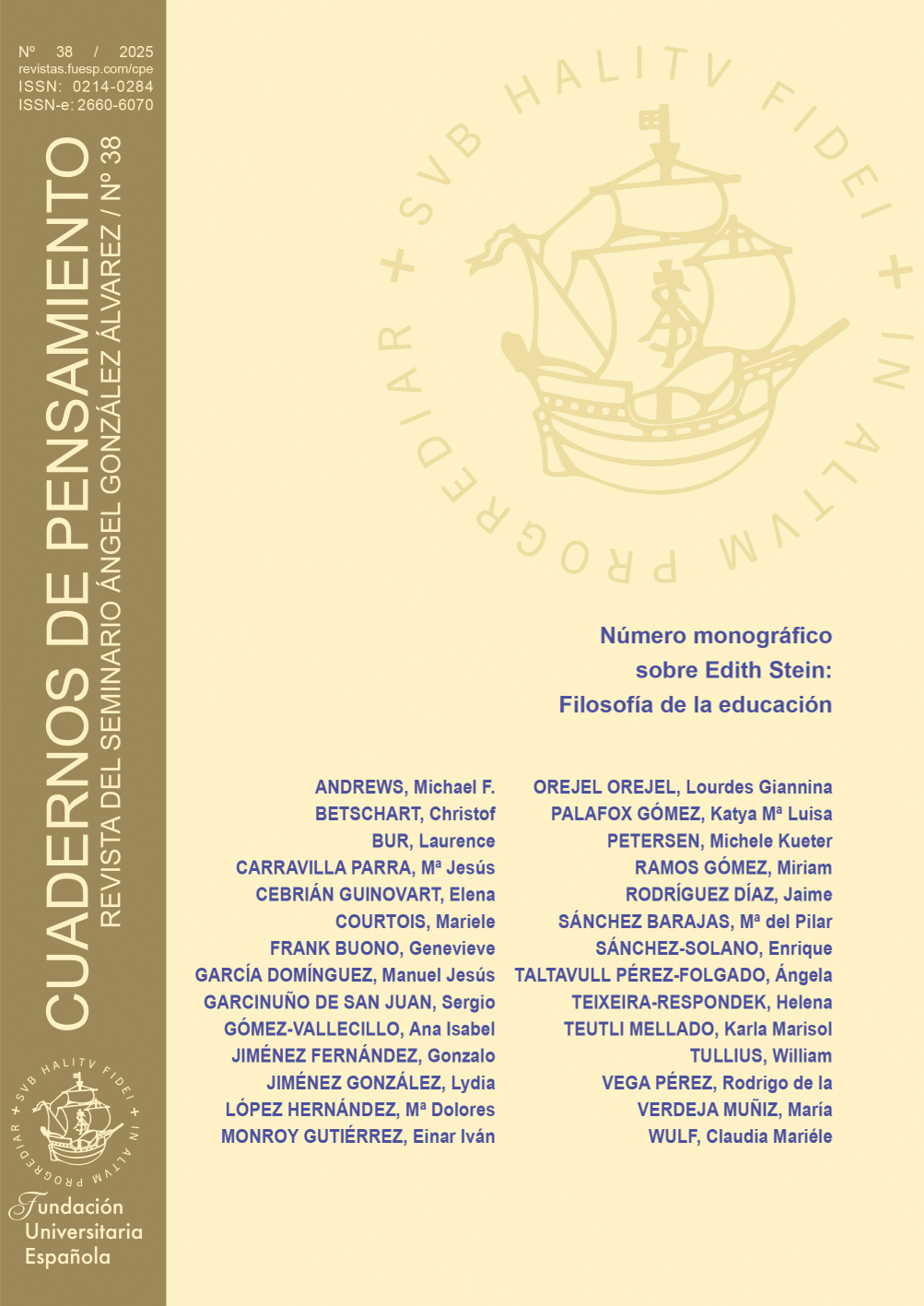
La comunidad como concepto central de la teoría política y educativa según Edith Stein
DOI:
https://doi.org/10.51743/cpe.473Keywords:
comunidad, educación, fenomenología, misticismo, políticaAbstract
La rica visión educativa que Edith Stein desarrolló a la luz de la fe cristiana debe entenderse a la luz de su temprana conciencia política y del pensamiento político que esbozó a finales de los años veinte, en su periodo estrictamente fenomenológico. Su análisis del concepto de comunidad, que la llevó a criticar las teorías del contrato social, ocupa un lugar central. Este artículo muestra la continuidad entre la visión política propuesta por la joven Edith Stein en su periodo fenomenológico y su visión de la educación, desarrollada tras su bautismo y su inmersión en el pensamiento de Santo Tomás de Aquino. Tras esbozar el papel determinante del concepto de comunidad en su pensamiento político, mostramos cómo este concepto es también esencial para comprender su visión educativa. La mística de la educación que desarrolló en los años treinta parece ser lo que podríamos llamar una mística de la comunidad.
Downloads
References
Aucante, V. (2006). De la solidarité. Essai sur la philosophie politique d’Edith Stein. Parole et Silence.
Aucante, V. (2022). L’État et les communautés: exploration de la philosophie politique d’Edith Stein. In J.-F. Lavigne (Ed.). Penser avec Edith Stein (133-153). Hermann.
Beckmann-Zöller, B. (2006). Die Herausforderung des Gemeinschaft-Gedankens für katholische Denker im zeitgenössischen Umfeld Edith Steins. In B. Beckmann-Zöller, H.-B. Gerl-Falkovitz (Ed.). Die unbekannte Edith Stein:Phänomenologie und Sozialphilosophie. Peter Lang.
Binggeli, S. (2022). De la personne humaine, Münster 1932–1933: une oeuvre de combat ? In J.-F. Lavigne (Ed.). Penser avec Edith Stein (133-153). Hermann.
Bouillot, B. (2015). Le Noyau de l’âme selon Edith Stein. Hermann.
De Rus, E. (2014). La Vision éducative d’Edith Stein. Salvator.
De Rus, E. (2019). Anthropologie phénoménologique et théorie de l’éducation dans l’oeuvre d’Edith Stein. Cerf.
Gerl-Falkovitz, H.-B. (2006). Introduction to B. Beckmann-Zöller, H.-B. Gerl-Falkovitz (Ed.). Die unbekannte Edith Stein:Phänomenologie und Sozialphilosophie. Peter Lang.
Ingarden, R. (1979). Über die philosophischen Forschungen Edith Steins. Freiburger Zeitschrift für Philosophie und Theologie (26), 456-480.
Lebech, M. (2010). Edith Stein’s Value Theory and its Importance for her Conception of the State. In H.-B. Gerl-Falkovitz, R. Kaufmann, H.R. Sepp (Ed.). Europa und seine Anderen. Emmanuel Levinas, Edith Stein, Josef Tischner. W.e.b Universitätsverlag.
Stein, E. (2000a). Selbstbildnis in Briefen I, Edith Steins Gesamtausagabe 2 (abbreviated to ESGA 2). Herder.
Stein, E. (2000b). Selbstbildnis in Briefen II, ESGA 3. Herder.
Stein, E. (2000c). Die Frau, ESGA 13. Herder.
Stein, E. (2001a). Aus dem Leben einer jüdischen Familie, ESGA 1. Herder.
Stein, E. (2001b). Selbstbildnis in Briefen. Briefe an Roman Ingarden, ESGA 4. Herder.
Stein, E. (2001c). Bildung und Entfaltung der Individualität, ESGA 16. Herder.
Stein, E. (2004). Der Aufbau der menschlichen Person, ESGA 14. Herder.
Stein, E. (2005). Was ist der Mensch ? ESGA 15. Herder.
Stein, E. (2006). Eine Untersuchung über den Staat, ESGA 7. Herder.
Stein, E. (2008). Zum Problem der Einfühlung, ESGA 5. Herder.
Stein, E. (2010). Beiträge zur philosophischen Begründung der Psychologie und der Geisteswissenschaften, ESGA 6. Herder.
Downloads
Published
Versions
- 2025-12-09 (3)
- 2025-12-09 (2)
- 2025-12-05 (1)
How to Cite
Issue
Section
License
Copyright (c) 2025 Bur Laurence

This work is licensed under a Creative Commons Attribution-NonCommercial 4.0 International License.
The author reserves the rights (copyright) of the published works, and the journal encourages and allows their reuse, from the preprint. The works are published in the electronic edition of the journal under a license "Creative Commons Attribution / Attribution-NonCommercial 4.0 International Public License - CC BY-NC 4.0", and can be copied, used, disseminated, transmitted and publicly exhibited.
The author / s partially transfer the property rights (copyright) of this work for the printed and online editions, provided that:
- The authorship and original source of its publication (magazine, publisher and URL of the work) is cited.
- Are not used for commercial purposes.
- The existence and specifications of this user license are mentioned.
It also declares to have respected the ethical principles of research and to be free from any conflict of interest.
"C.P.E." encourages the authors and the scientific community to the maximum promotion and dissemination of the works in their final version through:
1) Your list of contacts (emails) and social networks (Facebook, Twitter, LinkedIn ...).
2) Institutional repository of your University and public repositories (Mendeley, Cosis ...).
3) Scientific social networks (ResearchGate, Academia.edu, Kudos ...).
4) Personal or institutional website, blog, etc.
5) Google Scholar, ORCID, ResearchID, ScopusID, Dimensions, PlumX ...
6) Printed copies purchased directly and sent to specialists for reading and subsequent citation if appropriate.





















1.png)
1.png)

1.png)


.png)
.png)

.png)
1.png)
1.png)