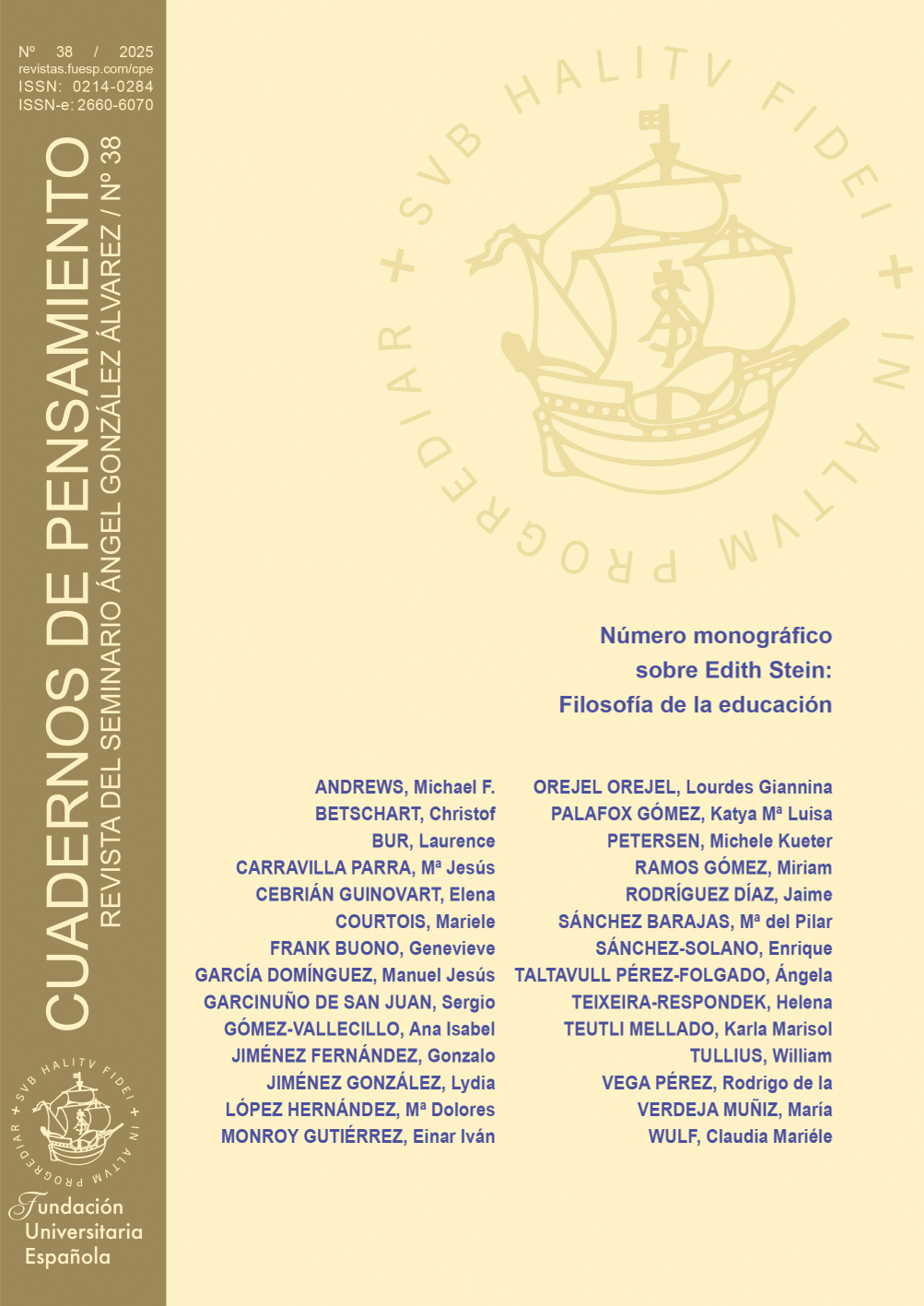
Formación holística y/o excelencia unilateral en la filosofía de la educación de Edith Stein
DOI:
https://doi.org/10.51743/cpe.483Keywords:
antropología filosófica, antropología teológica, Edith Stein, filosofía de la educación, formación especializada, formación holísticaAbstract
Según Edith Stein, el desarrollo de la esencia propia está limitado por la fuerza vital de uno mismo, de tal modo que es imposible materializar todo el potencial de la personalidad propia. Para la educación, una de las consecuencias de este supuesto es que debemos elegir entre una formación holística o una formación especializada centrada en la excelencia en un área específica. Por un lado, Stein admite que “[t]he individual human being’s power is so limited that he or she has to pay for the highest accomplishments in one field by shortcomings or deficiencies in other fields” (Stein, 2002, 507 [424]). Por otro lado, intenta evitar una elección excluyente entre las dos opciones argumentando a favor de una dependencia mutua en la que la plenitud no solo es la condición para una especialización en profundidad, sino que, a la inversa, la especialización puede abrir la puerta a lo que ella denomina “verdadera humanidad”. Esta vía media se mantiene y desarrolla en su cosmovisión cristiana, en la que la vocación a la comunión con el Dios Trino es personal y, como tal, única, pero consiste en el despliegue de la capacidad propia de amar de un modo que implica todas las dimensiones de la humanidad propia.
Downloads
References
Betschart, C. (2017). Despliegue y desarrollo de la individualidad personal según Edith Stein (A. Meis Wörmer, Trans.). Steiniana. Revista de Estudios Interdisciplinarios, 1(1), 97–125. https://doi.org/10.7764/Steiniana.1.2017.6
Betschart, C. (2009). Was ist Lebenskraft? Edith Steins erkenntnistheoretischen Prämissen in “Psychische Kausalität” (Teil 1). Edith Stein Jahrbuch, 15, 154–183. https://sonar.ch/global/documents/302301
Betschart, C. (2010). Was ist Lebenskraft? Edith Steins anthropologischer Beitrag in “Psychische Kausalität” (Teil 2). Edith Stein Jahrbuch, 16, 33–64. https://sonar.ch/global/documents/302293
Bur, L. (2023). L’expérience de la liberté selon Edith Stein. Un chemin entre deux abîmes. Cerf.
de Rus, É. (2019). Anthropologie phénoménologique et théorie de l’éducation dans l’oeuvre d’Edith Stein. Cerf.
de Rus, É. (2022). Anthropologie et éducation selon Edith Stein: Une approche de la destination surnaturelle de la personne humaine. Revista Portuguesa de Filosofia, 78(1–2), 381–402. https://doi.org/10.17990/RPF/2022_78_1_0381
Lunghini, G. (2023). La metafisica della natura in Potenza e atto di Edith Stein. Athenaeum Sant’Anselmo.
McNamara, R. (2020). Edith Stein’s Conception of Human Unity and Bodily Formation: A Thomistically Informed Understanding. American Catholic Philosophical Quarterly, 94(4), 639–663. https://doi.org/10.5840/acpq202099208
Raschke, R. (2017). Self-Realization of the Human Being: Stein’s Phenomenological Understanding of Education and her Contribution to Educational Practice. In H.- B. Gerl-Falkovitz & M. Lebech (Eds.), Edith Steins Herausforderung heutiger Anthropologie, Akten der Internationalen Konferenz 23.-25. Oktober 2015 in Wien und Heiligenkreuz (269–290). Be&Be.
Stein, E. (1986). Life in a Jewish Family: Her Unfinished Autobiographical Account (J. Koeppel, Trans.). ICS Publications.
Stein, E. (1989). On the Problem of Empathy (W. Stein, Trans.; 3rd ed.). ICS Publications.
Stein, E. (1996). Essays on Woman (F. M. Oben, Trans.; 2nd ed.). ICS Publications.
Stein, E. (2000). Philosophy of Psychology and the Humanities (M. Sawicki & C. Baseheart, Trans.). ICS Publications.
Stein, E. (2001a). Bildung und Entfaltung der Individualität: Beiträge zum christlichen Erziehungsauftrag (B. Beckmann & M. A. Neyer, Eds.). ESGA 16. Herder.
Stein, E. (2001b). Selbstbildnis in Briefen III. Briefe an Roman Ingarden (M. A. Neyer & H.-B. Gerl, Eds.). ESGA 4. Herder.
Stein, E. (2002). Finite and Eternal Being: An Attempt at an Ascent to the Meaning of Being (K. F. Reinhardt, Trans.). ICS Publications.
Stein, E. (2004). Der Aufbau der menschlichen Person: Vorlesung zur philosophischen Anthropologie (B. Beckmann, Ed.). ESGA 14. Herder.
Stein, E. (2009). Potency and Act: Studies Toward a Philosophy of Being (W. Redmond, Trans.). ICS Publications.
Stein, E. (2014). Letters to Roman Ingarden (H. Candler Hunt, Trans.). ICS Publications. Torralba Rosselló, F. (2020). Formar personas: La teología de la educación de Edith Stein. BAC.
Downloads
Published
Versions
- 2025-12-09 (3)
- 2025-12-09 (2)
- 2025-12-05 (1)
How to Cite
Issue
Section
License
Copyright (c) 2025 Christof Betschart

This work is licensed under a Creative Commons Attribution-NonCommercial 4.0 International License.
The author reserves the rights (copyright) of the published works, and the journal encourages and allows their reuse, from the preprint. The works are published in the electronic edition of the journal under a license "Creative Commons Attribution / Attribution-NonCommercial 4.0 International Public License - CC BY-NC 4.0", and can be copied, used, disseminated, transmitted and publicly exhibited.
The author / s partially transfer the property rights (copyright) of this work for the printed and online editions, provided that:
- The authorship and original source of its publication (magazine, publisher and URL of the work) is cited.
- Are not used for commercial purposes.
- The existence and specifications of this user license are mentioned.
It also declares to have respected the ethical principles of research and to be free from any conflict of interest.
"C.P.E." encourages the authors and the scientific community to the maximum promotion and dissemination of the works in their final version through:
1) Your list of contacts (emails) and social networks (Facebook, Twitter, LinkedIn ...).
2) Institutional repository of your University and public repositories (Mendeley, Cosis ...).
3) Scientific social networks (ResearchGate, Academia.edu, Kudos ...).
4) Personal or institutional website, blog, etc.
5) Google Scholar, ORCID, ResearchID, ScopusID, Dimensions, PlumX ...
6) Printed copies purchased directly and sent to specialists for reading and subsequent citation if appropriate.





















1.png)
1.png)

1.png)


.png)
.png)

.png)
1.png)
1.png)