Human interiority and the drama of freedom Anthropological and ethical contents of the second biblical account of creation and the sermon on the mount, according to Karol Wojtyla
DOI:
https://doi.org/10.51743/cpe.509Keywords:
freedom, interiority, self-determination, solitude, Theology of the bodyAbstract
This study analyzes the experience of interiority and its relationship with freedom, according to the Theology of the Body. Starting from the biblical account of Adam’s creation and the words of Jesus in the Sermon on the Mount, it describes the interiority of human beings as the ultimate source of their capacity for self-determination. It concludes that human interiority is the space where the battle for authentic freedom is fought. For this reason, it proposes an anthropology based on interiority. From it flows a vision of ethics more attentive to the impulses of the heart than to external behavior, without falling into subjectivism or moral relativism. This is the novelty that the Sermon on the Mount brought to the Old Law. It is also the novelty of the Theology of the Body in relation to numerous manuals of anthropology and morality. It presents human life as gift and task: man responds to the gift of creation with the task of accepting himself as a creature, affirming his being freely through action.
Downloads
References
Anderson, C. A., & Granados, J. (2012). Llamados al amor: Teología del cuerpo en Juan Pablo II (2.a ed.). Monte Carmelo.
Buttiglione, R. (1982). Il pensiero di Karol Wojtyła. Jaca Book.
Catecismo de la Iglesia Católica. (1993). Asociación de Editores del Catecismo. Abreviatura: CIC.
Crosby, J. F. (1985). Persona est sui iuris: Reflections on the foundations of Karol Wojtyla’s philosophy of the person. En R. Buttiglione, A. Scola, & C. Fedeli (Eds.), Karol Wojtyla: Filosofo, teologo, poeta (25-37). Libreria Editrice Vaticana.
Crosby, J. F. (2007). La interioridad de la persona humana: hacia una antropología personalista. Encuentro. Frossard, A. (1982). N’ayez pas peur! Robert Laffont.
Guerra, R. (2002). Volver a la persona. El método filosófico de Karol Wojtyla (1.a ed.). Caparrós.
Juan Pablo II. (2017). Hombre y mujer los creó: El amor humano en el plano divino (4.a ed.). Ediciones Cristiandad. Abreviatura: TDC.
López, A. (2019). Filiazione. En Dizionario su sesso, amore e fecondità (381-388). Cantagalli.
Merecki, J. (2015). Corpo e trascendenza: L’antropologia filosofica nella teologia del corpo di Giovanni Paolo II. Cantagalli.
Millán-Puelles, A. (1994). La libre afirmación de nuesro ser. Rialp.
Polo, L. (2015). Lecciones de psicología clásica: Vol. XXII (2.a ed.). Eunsa.
Schmitz, K. L. (1993). At the center of the human drama: The philosophical anthropology of Karol Wojtyła/Pope John Paul II. Catholic University of America Press.
Styczen, T. (2001). Introduzione. Essere se stessi è trascendere se stessi Sull’etica di Karol Wojtyła come antropologia normativa. En G. Reale (Ed.)L. Crisanti (Trad.), Metafisica della persona (1.a ed., 781-827). Bompiani.
Wojtyla, K. (1986). Ejercicios espirituales para jóvenes (2.a ed.). Biblioteca de Autores Cristianos.
Wojtyla, K. (1990). Hermano de Nuestro Dios; Esplendor de Paternidad: Dramas. Biblioteca de Autores Cristianos.
Wojtyla, K. (1998a). El problema de la voluntad en el análisis del acto ético (1957). En P. Ferrer (Trad.), Mi visión del hombre: Hacia una nueva ética (3.a ed., 153-184). Palabra.
Wojtyla, K. (1998b). La estructura general de la autodecisión (1974). En J. Pérez-Soba Díez del Corral (Ed.) P. Ferrer (Trad.), El hombre y su destino: Ensayos de antropología (1.a ed., 171-185). Palabra.
Wojtyla, K. (1998c). Trascendencia de la persona en el obrar y autoteleología del hombre (1976). En J. Pérez-Soba Díez del Corral (Ed.) P. Ferrer (Trad.), El hombre y su destino: Ensayos de antropología (1.a ed., 133-151). Palabra.
Wojtyla, K. (2011). Persona y acción. Palabra.
Wojtyla, K. (2014a). El acto y la vivencia ética (Curso 1954-1955). En R. Mora (Trad.), Lecciones de Lublin (I) (28-145). Palabra.
Wojtyla, K. (2014b). La cuestión de la norma y la felicidad (Curso 1956-1957). En Lecciones de Lublin (II) (36-370). Palabra.
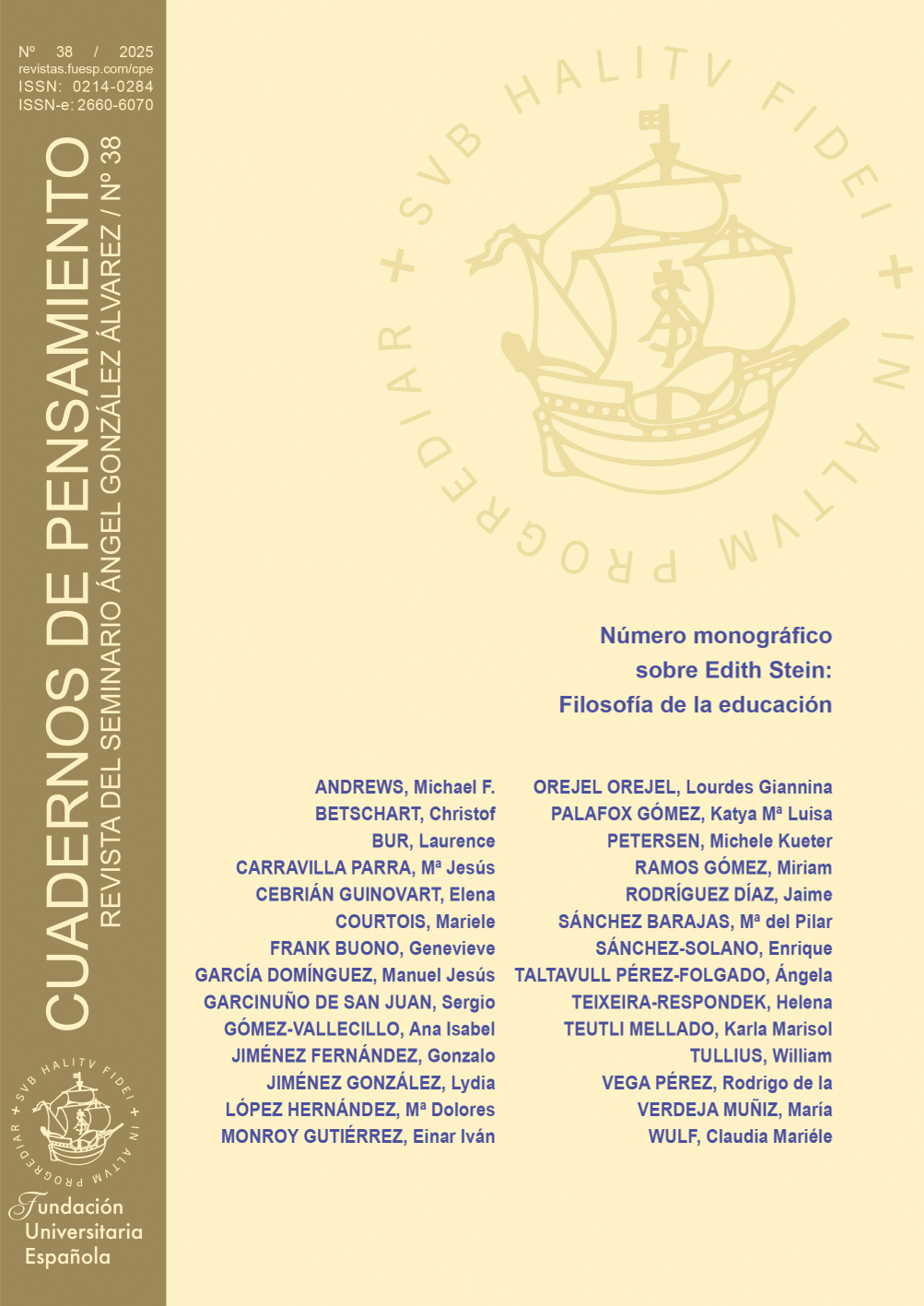
Downloads
Published
How to Cite
Issue
Section
License
Copyright (c) 2025 Jaime Rodríguez Díaz

This work is licensed under a Creative Commons Attribution-NonCommercial 4.0 International License.
The author reserves the rights (copyright) of the published works, and the journal encourages and allows their reuse, from the preprint. The works are published in the electronic edition of the journal under a license "Creative Commons Attribution / Attribution-NonCommercial 4.0 International Public License - CC BY-NC 4.0", and can be copied, used, disseminated, transmitted and publicly exhibited.
The author / s partially transfer the property rights (copyright) of this work for the printed and online editions, provided that:
- The authorship and original source of its publication (magazine, publisher and URL of the work) is cited.
- Are not used for commercial purposes.
- The existence and specifications of this user license are mentioned.
It also declares to have respected the ethical principles of research and to be free from any conflict of interest.
"C.P.E." encourages the authors and the scientific community to the maximum promotion and dissemination of the works in their final version through:
1) Your list of contacts (emails) and social networks (Facebook, Twitter, LinkedIn ...).
2) Institutional repository of your University and public repositories (Mendeley, Cosis ...).
3) Scientific social networks (ResearchGate, Academia.edu, Kudos ...).
4) Personal or institutional website, blog, etc.
5) Google Scholar, ORCID, ResearchID, ScopusID, Dimensions, PlumX ...
6) Printed copies purchased directly and sent to specialists for reading and subsequent citation if appropriate.




















1.png)
1.png)

1.png)


.png)
.png)

.png)
1.png)
1.png)