Educational leadership in Edith Stein: perspectives and updates
DOI:
https://doi.org/10.51743/cpe.454Keywords:
Edith Stein, education, leadership, teacher training, teaching-learningAbstract
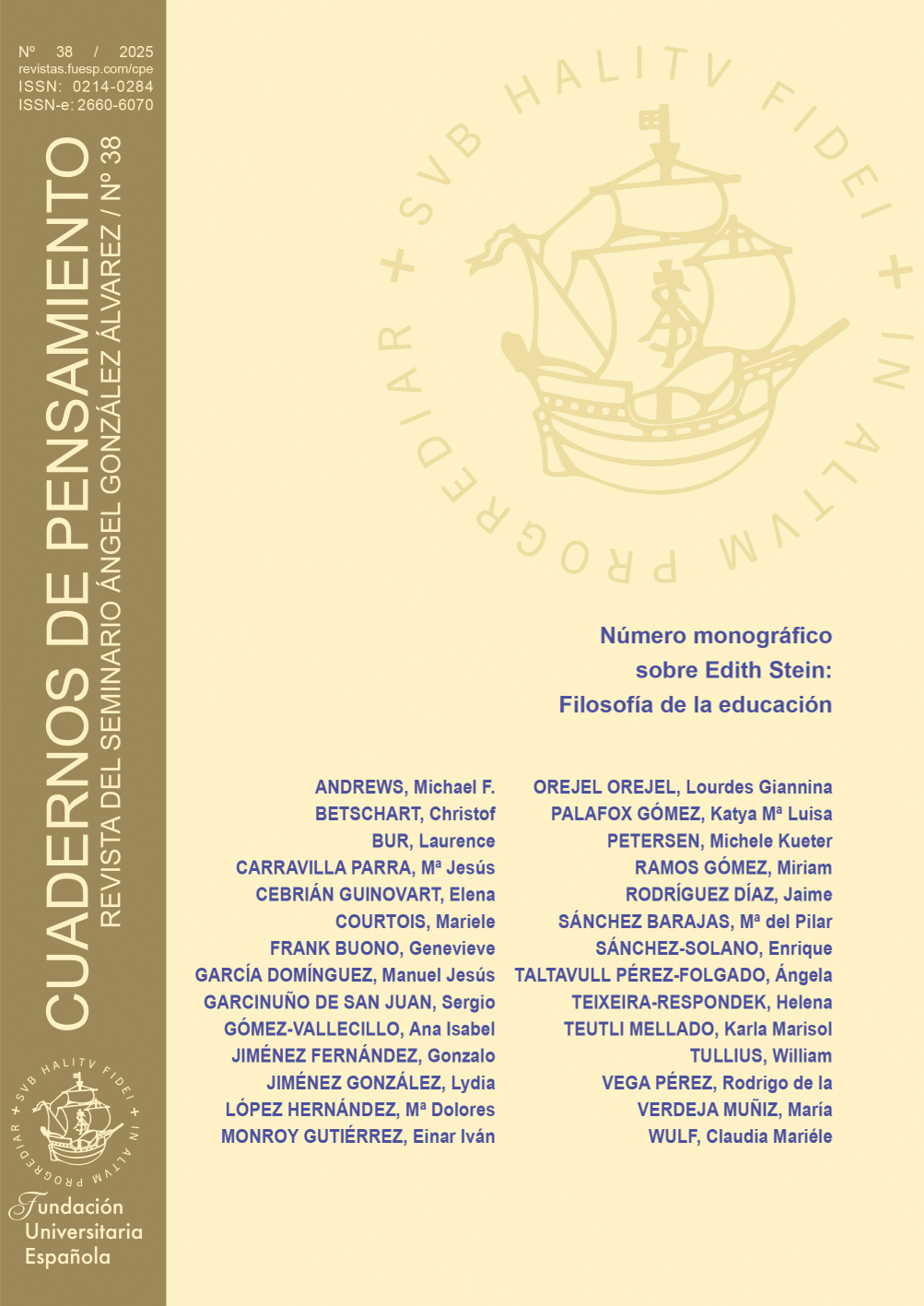
As it becomes increasingly evident that pedagogical leadership in the 21st century must be a distributed function involving school administration, middle management, and teachers, this article focuses on the latter group to explore the viability of a specifically Steinian educational leadership model. According to Edith Stein’s leadership model, the art of education encompasses the development of both intellect and the will and emotions, while grounding itself in the authentic structure of the human person, which should guide all educational endeavors. It is from this pedagogicalanthropological
perspective developed by Stein that the learner is assisted in becoming a true human being, attaining the truth of one’s being and genuine individuality. This article will analyze Stein’s pedagogical writings, her personal experience as a student, and her teaching role as a professor. An examination of these facets will enable us to
present an educational model with the capacity to transform educators into the educational leaders that contemporary society requires more than ever.
Downloads
References
Adams, D., Samat, S. N. A., y Samah, H. A. (2018). Teacher leadership: Going beyond classroom. International Online Journal of Educational Leadership, 2(1), 1-3. doi.org/10.22452/iojel.vol2no1.1
Bombino, L. L., y Jiménez Puerto, C. L. (2019). La preparación del docente y su papel
como líder del proceso enseñanza-aprendizaje. Atlante Cuadernos de Educación y Desarrollo (julio). https://www.eumed.net/rev/atlante/2019/07/preparacion-docente-ensenanza.html
García-Rojo, J. (2000). Edith Stein: balance bibliográfico. Estudios Eclesiásticos. Revista de investigación e información teológica y canónica, 75 (292), 101-127.
González-Pérez, A. (2021). Bienestar emocional y el docente: un diario creativo en emociones. RIDE. Revista Iberoamericana para la Investigación y el Desarrollo Educativo, 12 (23), 1-30.
Gumus, S., Bellibas, M. S., Esen, M., y Gumus, E. (2018). A systematic review of studies on leadership models in educational research from 1980 to 2014. Educational Management Administration & Leadership, 46 (1), 25-48.
Hallinger, P., y Kulophas, D. (2020). The evolving knowledge base on leadership and teacher professional learning: a bibliometric analysis of the literature, 1960-2018. Professional development in education, 46 (4), 521-540.
Hatt, B. E. (2005). Pedagogical love in the transactional curriculum. Journal of curriculum studies, 37 (6), 671-688.
Heifetz, R., Grashow, A. y Linsky, M. (2016). La práctica del liderazgo adaptativo. Las herramientas y tácticas para cambiar su organización y el mundo. Revista EAN, 81 (2), 236-241. INTEF (2017). Marco Común de Competencia Digital Docente. https://aprende.intef.es/sites/default/files/2018-05/2017_1020_Marco-Com%C3%BAn-de-Competencia-Digital-Docente.pdf
INTEF (2022). Marco Común de Competencia Digital Docente. Madrid: Instituto Nacional de Tecnologías Educativas y Formación del Profesorado. http://aprende.intef.es/sites/default/files/2023-02/MRCDD_V06B_GTTA.pdf
Kovačević, J., y Hallinger, P. (2020). Finding Europe’s niche: Science mapping the knowledge base on educational leadership and management in Europe, 1960–2018. School Effectiveness and School Improvement, 31(3), 405-425. https://doi.org/10.1080/09243453.2019.1692875
Leithwood, K. y Sun, J. (2018). Academic Culture: A Promising Mediator of School Leaders’ Influence on Student Learning. Journal of Educational Administration 56 (3), 350–363.
Ley Orgánica 3/2020, de 29 de diciembre, por la que se modifica la Ley Orgánica 2/2006, de 3 de mayo, de Educación. Boletín Oficial del Estado, 340, de 30 de diciembre de 2020, 122868-122953. https://www.boe.es/boe/dias/2020/12/30/pdfs/BOE-A-2020-17264.pdf
Maya, E., Zavala, J. J. A., y Argüelles, J. I. (2019). Liderazgo directivo y educación de calidad. Cienciamatria, 5 (9), 114-129.
Mulford, B. (2006). Liderazgo para mejorar la calidad de la educación secundaria: algunos desarrollos internacionales. Profesorado. Revista de currículum y formación del profesorado, 10 (1), 1-22. https://www.ugr.es/~recfpro/rev101ART2.pdf
Muñoz, M. M. (2021). Edith Stein (1891-1942): política y educación como herramientas de cambio social en favor de la mujer en los inicios del siglo xx. Cuadernos de pensamiento (34), 81-108.
Octavio Ortiz de Montellano, L. C. (2015). Edith Stein, el ethos femenino y el papel de la mujer en la enseñanza. Ecclesia, 29(3-4), 229-257.
Peretti, C. (2010). Pedagogia da empatia eo diálogo com as Ciências Humanas em Edith Stein. Revista da Abordagem Gestáltica: Phenomenological Studies, 16(2), 199-207.
Riascos-Hinestroza L. E. y Becerril-Arostegui, I. (2021). Liderazgo educativo docente. Un modelo para su estudio, discusión y análisis. Educación y Educadores, 24(2), 243-264. https://doi.org/10.5294/edu.2021.24.2.4
Robinson, V. M., Hohepa, M., y Lloyd, C. (2007). School leadership and student outcomes: Identifying what works and why (Vol. 41, 1-27). Australian Council for Educational Leaders.
Roslan, M. F., Abd Razak, M. R., Abdullah, K. H., y Ishak, N. S. (2023). Analyzing the Evolution of Teacher Leadership Research in 32 Years (1990-2022): A Bibliometric Analysis. Asian Journal of Research in Education and Social Sciences, 5(2), 209-224.
Sancho, F. J. (1998). Introducción General. En F. J. Sancho (Ed.), Edith Stein. Obras selectas. ( 5-18). Monte Carmelo.
Sancho, F. J. (2003). Edith Stein, formadora integral de la persona. En: J. Urkiza y F. J. Sancho (Dirs.), Edith Stein. Obras completas, Escritos antropológicos y pedagógicos (Magisterio de vida cristiana, 1926-1933) (Vol. IV, 29-44). Monte Carmelo.
Stein, E. (2002). Autobiografía. Vida de una familia judía. En: J. Urkiza y F. J. Sancho (Dirs.), Edith Stein. Obras completas, Escritos autobiográficos y Cartas (Vol. I, 151-510). Monte Carmelo. (Trabajo original publicado 1965).
Stein, E. (2003). Obras completas IV, Escritos antropológicos y pedagógicos. Monte Carmelo.
Stein, E. (2005). Obras completas V, Escritos espirituales. Monte Carmelo.
Stein, E. (2006). Sobre el problema de la empatía. En: J. Urkiza y F. J. Sancho (Dirs.), Edith Stein. Obras completas, Escritos filosóficos (Etapa fenomenológica (1915-1920) (Vol. II, 79-202). Monte Carmelo. (Trabajo original publicado 1917). Talledo-Villacís, M. I., Vera-Torres, A. R. A., Loor-Bermeo, M. J., Loor-Bermeo, E. F. y Cantos-Ventura, X. M. (2023). El liderazgo docente: apoyo socioemocional en el aula. Ciencia Latina Revista Científica Multidisciplinar, 7 (1), 5095-5113. https://doi.org/10.37811/cl_rcm.v7i1.4818
UNESCO (2015). Replantear la educación ¿Hacia un bien común mundial? Ediciones Unesco. https://unesdoc.unesco.org/ark:/48223/pf0000232697
Viaña, C. G. (2022). Edith Stein en su actividad como asistente de Edmund Husserl en Friburgo. Eikasía Revista de Filosofía (109), 191-220. https://doi.org/10.57027/eikasia.109.334
Warren, L. L. (2021). The importance of teacher leadership skills in the classroom. Education Journal, 10(1), 8-15.
Downloads
Published
How to Cite
Issue
Section
License
Copyright (c) 2025 Ana Isabel Gómez-Vallecillo, Enrique Sánchez-Solano

This work is licensed under a Creative Commons Attribution-NonCommercial 4.0 International License.
The author reserves the rights (copyright) of the published works, and the journal encourages and allows their reuse, from the preprint. The works are published in the electronic edition of the journal under a license "Creative Commons Attribution / Attribution-NonCommercial 4.0 International Public License - CC BY-NC 4.0", and can be copied, used, disseminated, transmitted and publicly exhibited.
The author / s partially transfer the property rights (copyright) of this work for the printed and online editions, provided that:
- The authorship and original source of its publication (magazine, publisher and URL of the work) is cited.
- Are not used for commercial purposes.
- The existence and specifications of this user license are mentioned.
It also declares to have respected the ethical principles of research and to be free from any conflict of interest.
"C.P.E." encourages the authors and the scientific community to the maximum promotion and dissemination of the works in their final version through:
1) Your list of contacts (emails) and social networks (Facebook, Twitter, LinkedIn ...).
2) Institutional repository of your University and public repositories (Mendeley, Cosis ...).
3) Scientific social networks (ResearchGate, Academia.edu, Kudos ...).
4) Personal or institutional website, blog, etc.
5) Google Scholar, ORCID, ResearchID, ScopusID, Dimensions, PlumX ...
6) Printed copies purchased directly and sent to specialists for reading and subsequent citation if appropriate.



















1.png)
1.png)

1.png)


.png)
.png)

.png)
1.png)
1.png)