Dialogue between the pedagogical thought of Edith Stein and the trascendental anthropology of Leonardo Polo
DOI:
https://doi.org/10.51743/cpe.458Keywords:
Edith Stein, Leonardo Polo, pedagogy, teaching, transcendental anthropologyAbstract
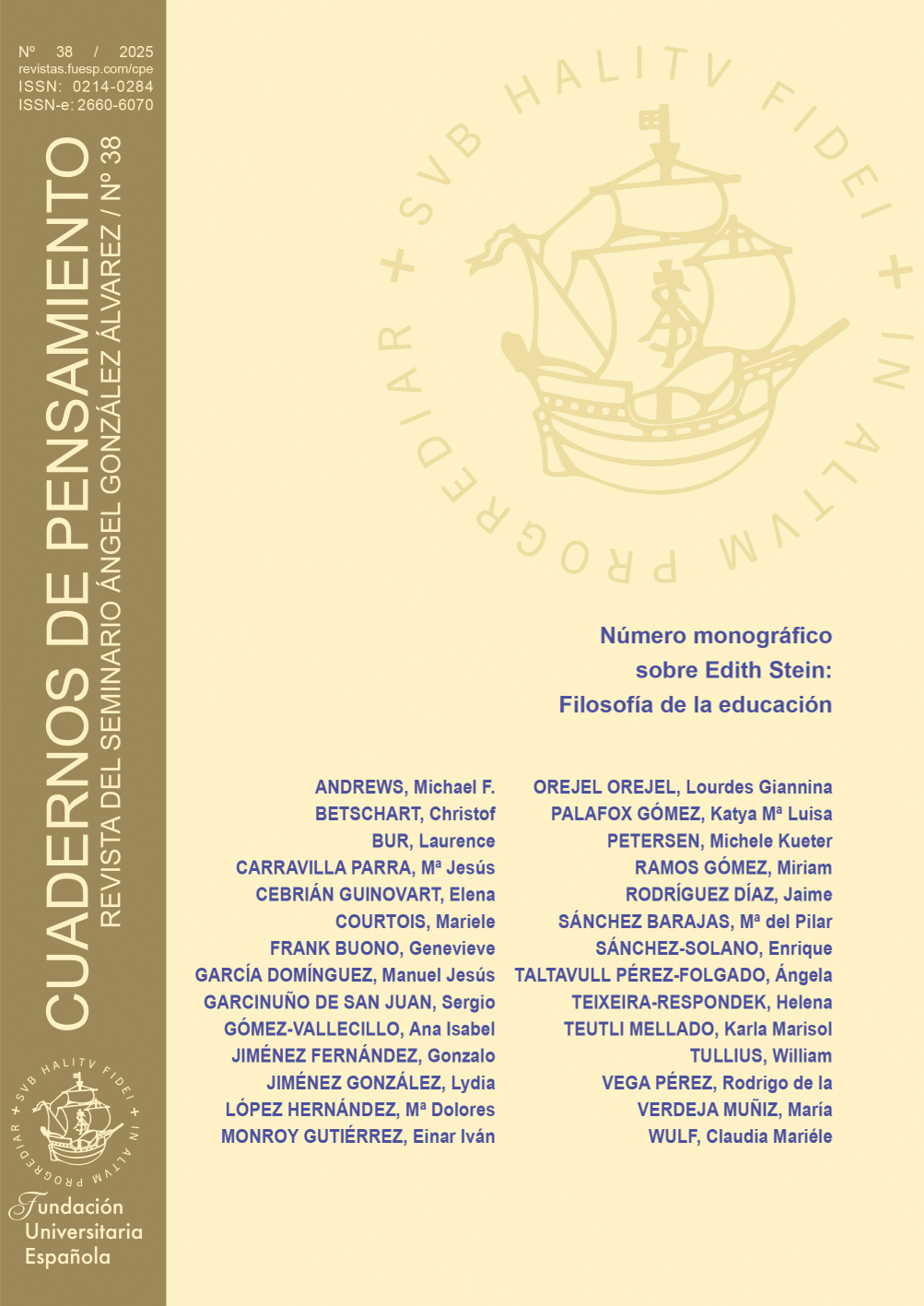
The creativity in Edith Stein’s pedagogical thought offers great potential that allows us to establish a dialogue with other thinkers: one of them being Leonardo Polo and his transcendental anthropology. Dialogue can inspire new ways of thinking about the person, knowledge, the educational meaning that shed light on the educational community. In particular, in the present study we are interested in focusing on teachers in training. The proposal consists of providing a series of pedagogical orientations that inspire future teachers and remined them of the potential and responsibility that their profession has at in a personal and in a community level. This unpublished dialogue between Edith Stein’s pedagogical thought from the theory of knowledge of Polo’s and his transcendental anthropology can provide new insights and answers about who the human person is, and about the importance of the educational sense of the teacher in training.
Downloads
References
Altarejos, F. (1986). Educación y felicidad. Pamplona, España: Eunsa.
Altarejos y Fontodona. (2003). Retos de la globalización. Pamplona, España: Eunsa.
Altarejos y Naval. (2004). Filosofía de la educación (2ª ed.). Pamplona: EUNSA.
Ballesteros, B. B. (2017). Manual de didáctica general para maestros de Educación Infantil y de Primaria. Madrid: Pirámide.
Berríos, F. (2017). El yo como espiritu en la antropología de Edith Stein y de Karl Rahner. Teología y vida, 109-128.
Cardona Moltó, M. (2002). Introducción a los Métodos de Investigación en Educación. Madrid: EOS.
Esparza, M. (1998). El pensamiento de Edith Stein. Pamplona: Eunsa.
Fidalgo, J. F. (2020). Antropología filosófica: la persona humana. Pamplona: Eunsa.
Izaguirre, J. (2007). Una antropología trascendental para la educación. La acción educativa según el pensamiento de Leonardo Polo. Excerpta e dissertationibus in Philosophia,17, 399-503.
Llano, A. (1998). Gnoseología. Pamplona: Eunsa.
Lorda, J. L. (1996). Antropología cristiana. Del Concilio Vaticano II a Juan Pablo II. Madrid: Palabra.
Moros, J. M. (2007). La acción educativa según la antropología trascendental de Leonardo Polo. Cuadernos de Anuario Filosófico, Serie Universitaria, 197, Pamplona.
Naval, C. (1995). Enseñanza y Comunicación. Pamplona: Eunsa.
Polo, L. (1999). La persona humana y su crecimiento. Pamplona: Eunsa.
Polo, L. (2006). Curso de teoría del conocimiento, tomo I. Pamplona: Eunsa.
Polo, L. (2015). Curso de teoría del conocimiento, II, vol.V. Pamplona: Eunsa.
Polo, L. (2015). El acceso al ser. Pamplona: Eunsa.
Polo, L. (2016). Antropología Trascendental. Pamplona: Eunsa.
Ratzinger, J. (1970). Introducción al cristianismo. Salamanca: Sígueme.
Rosa, S. F. (2017). La antropología dual de Edith Stein: una posible comprensión del género para los derechos humanos. Periódico do núcleo de Estudios e Pesquisas sobre género y direito, 222-238.
Sánchez, M. (2014). Desarrollo de habilidades del pensamiento. México: Trillas.
Sellés, J. F. (2019). Teoría del conocimiento. Pamplona: Eunsa.
Sellés, J. F. (2020). Antropología para inconformes. Madrid: Rialp.
Sellés, J. F. (s.f.). No el acto de conocer, sino el objeto conocido es intencional.
Stein, E. (1998). La estructura de la persona humana. Madrid: BAC.
Stein, E. (2005). Individuo y comunidad, en Obras completas, II. Burgos: Monte Carmelo.
Stein, E. (2005). ¿Qué es el hombre? La antropología de la doctrina católica de la fe, en obras completas. Burgos: Monte Carmelo.
Stein, E. (2005). Ser finito y ser eterno. Burgos: Monte Carmelo.
Stein, E. (2005). Sobre el problema de la empatía, en obras completas, vol. II. Burgos: Monte Carmelo.
Suárez, L. G. (2007). La presencia de Dios en el castillo interior. En torno a la complementariedad de la antropología mística de Santa Teresa de Jesús y la antropología fenomenológica de Edith Stein. Valenciana, 127-151.
Taibenshlag, C. (2020). Un aporte de Edith Stein a la antropología de su tiempo: la empatía. Sapientia, 55-78.
Downloads
Published
How to Cite
Issue
Section
License
Copyright (c) 2025 Katya María Luisa Palafox Gómez, María Dolores López Hernández

This work is licensed under a Creative Commons Attribution-NonCommercial 4.0 International License.
The author reserves the rights (copyright) of the published works, and the journal encourages and allows their reuse, from the preprint. The works are published in the electronic edition of the journal under a license "Creative Commons Attribution / Attribution-NonCommercial 4.0 International Public License - CC BY-NC 4.0", and can be copied, used, disseminated, transmitted and publicly exhibited.
The author / s partially transfer the property rights (copyright) of this work for the printed and online editions, provided that:
- The authorship and original source of its publication (magazine, publisher and URL of the work) is cited.
- Are not used for commercial purposes.
- The existence and specifications of this user license are mentioned.
It also declares to have respected the ethical principles of research and to be free from any conflict of interest.
"C.P.E." encourages the authors and the scientific community to the maximum promotion and dissemination of the works in their final version through:
1) Your list of contacts (emails) and social networks (Facebook, Twitter, LinkedIn ...).
2) Institutional repository of your University and public repositories (Mendeley, Cosis ...).
3) Scientific social networks (ResearchGate, Academia.edu, Kudos ...).
4) Personal or institutional website, blog, etc.
5) Google Scholar, ORCID, ResearchID, ScopusID, Dimensions, PlumX ...
6) Printed copies purchased directly and sent to specialists for reading and subsequent citation if appropriate.




















1.png)
1.png)

1.png)


.png)
.png)

.png)
1.png)
1.png)