Comprender la luz: la pedagogía contemplativa de Edith Stein
DOI:
https://doi.org/10.51743/cpe.475Keywords:
carmelitas, discernimiento, Edith Stein, pedagogía contemplativa, religiónAbstract
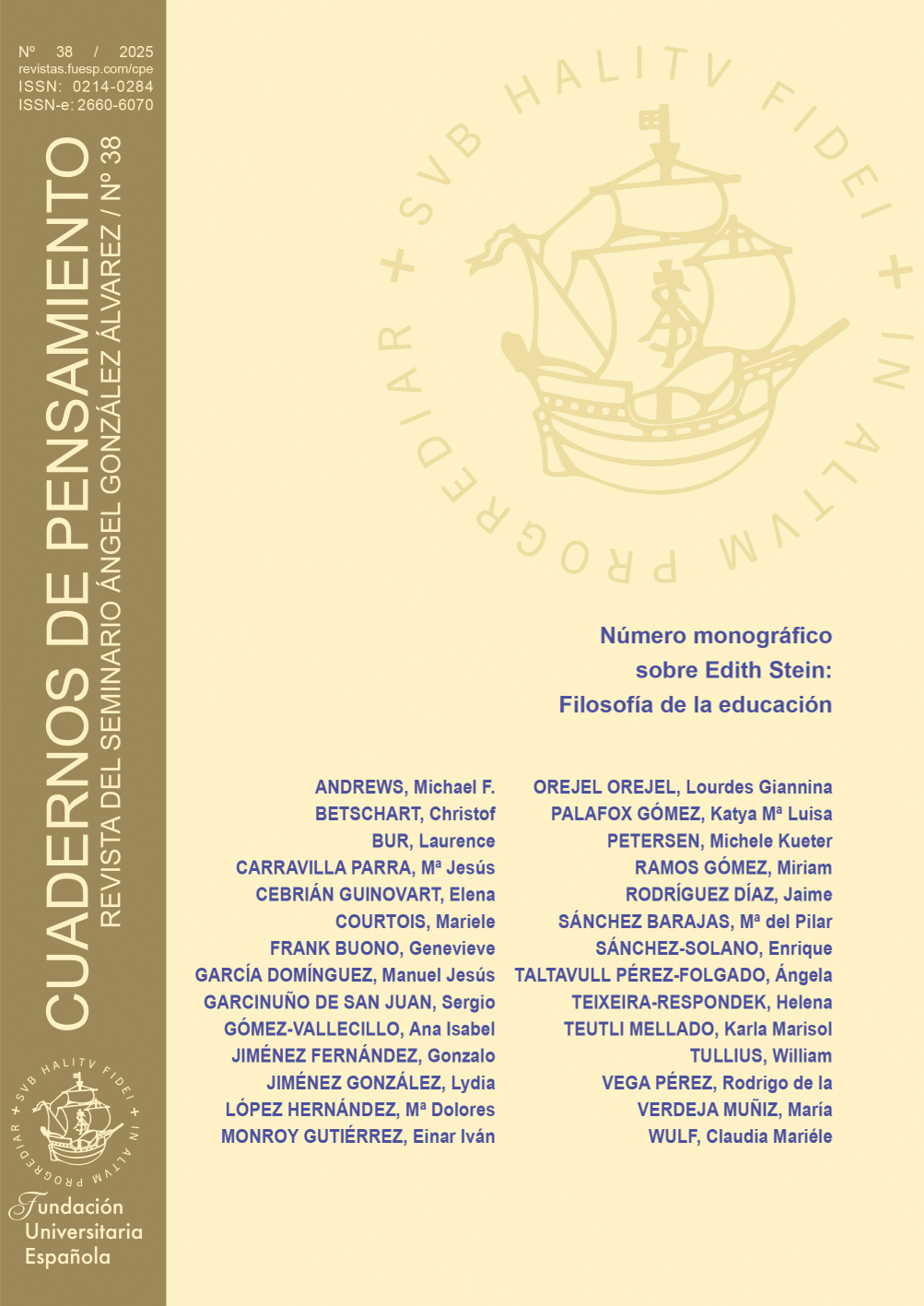
Cuando reflexionamos con Edith Stein sobre la educación y la religión, aprendemos a filosofar y a reflexionar tanto sobre lo que pensamos como sobre cómo pensamos lo que pensamos. Este artículo pretende poner de relieve las aportaciones filosóficas de Stein a la pedagogía religiosa, incluida su postura sobre la importancia de aceptar la voluntad divina para avanzar en el discernimiento espiritual. Bajo su tutela, lo que a menudo se inculca como la mera recepción pasiva de la luz de la fe reveladora se convierte en un acto filosóficamente iluminador de trascendencia transformadora. La llamada a enseñar y aprender cultiva así no solo una creencia pasiva, sino también el surgimiento de una fuerza moral que sienta las bases para una nueva era de la Ilustración centrada en un ser relacional portador de luz y verdadero, más que en la mera iluminación exterior de los hechos. En el cultivo de la interioridad, Stein imparte una regla de vida contemporánea en la enseñanza y el aprendizaje como vocación, mediante la cual la evolución de la individualidad se convierte en un flujo integrador entre la contemplación y la acción. Llevar y comprender la luz es aprender a ver de una nueva manera con los ojos de la fe. La relación entre el ser y el devenir en la intersección entre la educación, la vocación y la espiritualidad nos ayuda a reconocer en el misterio de nuestras vidas y por el bien de los demás lo que debemos hacer. Stein expone una pedagogía contemplativa del corazón que refleja el rigor intelectual de su educación filosófica y su formación en fenomenología, así como el vigor espiritual de su vida religiosa.
Downloads
References
Ales Bello, A. (2018). The spiritual life and its degrees according to Edith Stein. In K. M. Haney (Ed.), Listening to Edith Stein: Wisdom for a new century: A collection of essays (17-45). ICS Publications.
Barth, K. (1961). Church Dogmatics. Vol. III The Doctrine of Creation Pt. Four (G.W. Bromiley & T.F. Torrance, Eds.; A.T. Mackay, T.H.L. Parker, H. Knight, H.A. Kennedy, J. Marks, Trans.). T. & T. Clark.
Borden Sharkey, S. (2003). Edith Stein. Continuum.
Graef, H. C. (1954). The scholar and the cross: The life and work of Edith Stein. Roman Catholic Books.
Larkin, E. E. (2021). Silent presence: Discernment as process and problem (2nd ed.). Carmelite Media.
Petersen, M. K. (2021). A hermeneutics of contemplative silence: Paul Ricoeur, Edith Stein, and the heart of meaning. Lexington Books.
Pope John Paul II. (2000). Homily at Canonization Eucharist. In J. Sullivan (Ed.), Holiness befits your house: Documentation on the canonization of Edith Stein (pp. 7-11). ICS Publications.
Stein, E. (1993). Self-Portrait in letters, 1916-1942 (L. Gelber & R. Leuven, Eds.; J. Koeppel, Trans.). ICS Publications.
Stein, E. (1996). Essays on woman (L. Gelber & R. Leuven, Eds.; F. M. Oben, Trans.; 2nd Rev. ed.). ICS Publications.
Stein, E. (2000). Philosophy of psychology and the humanities (M. Sawacki, Ed.; M. C. Baseheart & M. Sawacki, Trans.). ICS Publications.
Stein, E. (2002a). Finite and eternal being: An attempt at an ascent to the meaning of being (L. Gelber & R. Leuven, Eds.; K. F. Reinhardt, Trans.). ICS Publications.
Stein, E. (2002b). The science of the cross (L. Gelber & R. Leuven, Eds.; J. Koeppel, Trans.). ICS Publications.
Stein, E. (2014). Edith Stein: Letters to Roman Ingarden (M. A. Neyer & E. Avé-Lallemant, Eds.; H. C. Hunt, Trans.). ICS Publications.
Downloads
Published
Versions
- 2025-12-10 (3)
- 2025-12-09 (2)
- 2025-12-05 (1)
How to Cite
Issue
Section
License
Copyright (c) 2025 Michele Kueter Petersen

This work is licensed under a Creative Commons Attribution-NonCommercial 4.0 International License.
The author reserves the rights (copyright) of the published works, and the journal encourages and allows their reuse, from the preprint. The works are published in the electronic edition of the journal under a license "Creative Commons Attribution / Attribution-NonCommercial 4.0 International Public License - CC BY-NC 4.0", and can be copied, used, disseminated, transmitted and publicly exhibited.
The author / s partially transfer the property rights (copyright) of this work for the printed and online editions, provided that:
- The authorship and original source of its publication (magazine, publisher and URL of the work) is cited.
- Are not used for commercial purposes.
- The existence and specifications of this user license are mentioned.
It also declares to have respected the ethical principles of research and to be free from any conflict of interest.
"C.P.E." encourages the authors and the scientific community to the maximum promotion and dissemination of the works in their final version through:
1) Your list of contacts (emails) and social networks (Facebook, Twitter, LinkedIn ...).
2) Institutional repository of your University and public repositories (Mendeley, Cosis ...).
3) Scientific social networks (ResearchGate, Academia.edu, Kudos ...).
4) Personal or institutional website, blog, etc.
5) Google Scholar, ORCID, ResearchID, ScopusID, Dimensions, PlumX ...
6) Printed copies purchased directly and sent to specialists for reading and subsequent citation if appropriate.



















1.png)
1.png)

1.png)


.png)
.png)

.png)
1.png)
1.png)